
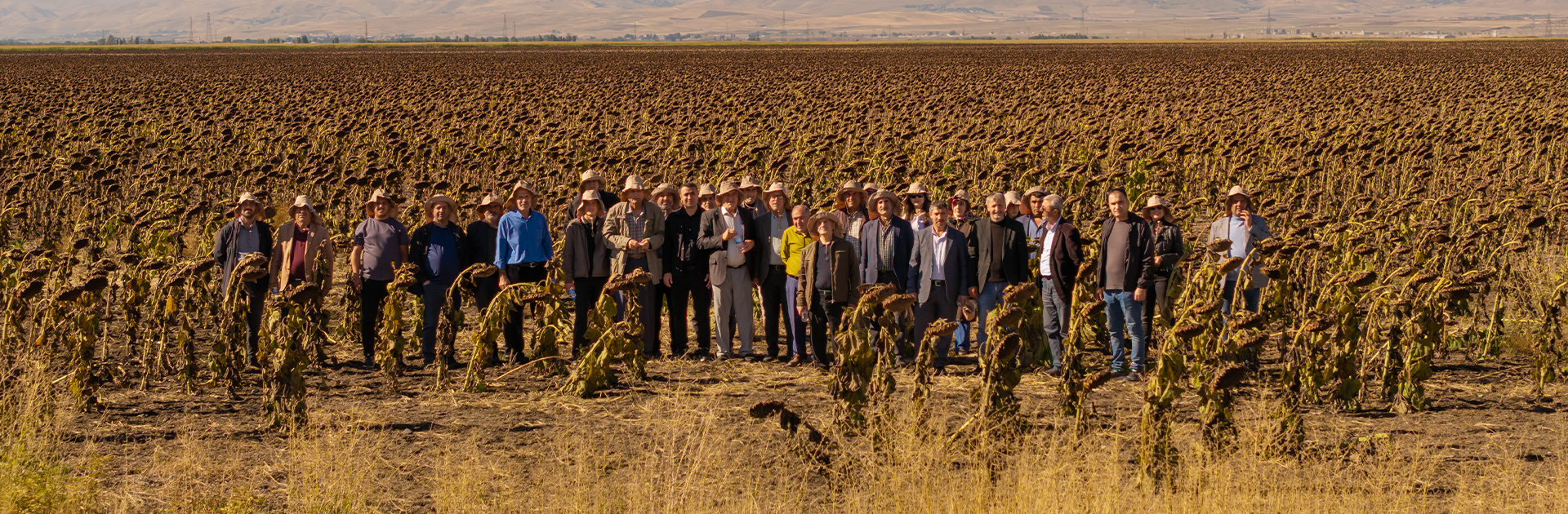
Through Tiryaki Farming Farmer Meetings, Tiryaki Agro is advancing regenerative agriculture together with farmers in Muş.
The fourth edition of the Tiryaki Farming Farmer Meetings, launched in line with Tiryaki Agro’s sustainability vision, was held on October 10, 2026, at the Muş Alparslan Agricultural Facility. Bringing together farmers from across the region, the event included an onsite review of regenerative agricultural practices in a sunflower field, alongside expert insights and field-based knowledge sharing on wheat production.
The Farmer Meetings represent one of the ways Tiryaki Agro brings its globally integrated value platform approach and corporate social responsibility efforts to the field. By encouraging the exchange of knowledge and good practices among farmers, the program aims to create social impact while contributing to agricultural sustainability.
Launched in Muş in December 2025 with 50 lead farmers, the program was designed to reach a total of 150 farmers across the region, support the adoption of regenerative agricultural practices and measure sustainability impacts. Across the four meetings held to date, crop-specific technical knowledge, data-driven soil management and farmer-to-farmer learning have been addressed together.
Topics covered throughout the meetings included wheat and sugar beet cultivation, regenerative agriculture, agricultural carbon footprint, budgeting, financial literacy and digital agriculture. Combining face-to-face training, field measurements and year-round digital support, the program aims to accelerate the adoption of regenerative practices, strengthen farmers’ knowledge and decision-making capabilities, and measure sustainability outcomes.
Productive, Resilient and Measurable Production
The first meeting was held on December 4, 2025, at the Muş Alparslan Agricultural Facility. The program covered climate-resilient wheat cultivation, an introduction to regenerative agriculture, the relationship between soil, water, biodiversity and carbon, next-generation wheat practices, and input optimization through digital technologies.
More than 20 lead farmers participated in the first meeting. In the pre-training survey, 78% of participants reported having limited knowledge of disease and pest management. Their priority training needs were disease and pest management (50%) and fertilization (43%). Following the training, 86% said their level of knowledge had increased, 86% reported that they would be able to apply the right criteria when selecting seeds, and 79% said the training would contribute to improving their yields. Overall, 93% of participants said they were satisfied or very satisfied with the training.
At the second meeting, held on February 9, 2026, wheat and sugar beet cultivation, digital technologies and farmer communication were among the main topics. Post-training feedback showed that 67% of participants reported a significant improvement in their knowledge, while 90% found the content relevant to their needs. Overall satisfaction was measured at 76%.
The third meeting, held at the Muş Alparslan Agricultural Facility on April 29, 2026, addressed agricultural carbon footprint, regenerative agriculture, budgeting and financial literacy alongside sugar beet and wheat cultivation. Approximately 60 farmers attended the program, where practical information was shared on seed and variety selection, soil preparation, fertilization, irrigation, disease and pest management, harvesting and storage, income and expense tracking, cost planning, and profitability.
Before the training, 78% of participants said they had little or no knowledge of financial literacy. Following the training, 96% reported gaining knowledge in this area. In addition, 92% said they had increased their awareness of carbon footprint and regenerative agriculture, while 73% stated that they would definitely apply what they had learned in the field. Overall satisfaction reached 94%.
With the fourth meeting, training moved directly into the field and the crop scope of the series expanded. During the October 10 meeting, farmers observed regenerative agricultural practices firsthand in a sunflower field and received information on wheat cultivation and fertilization practices tailored to conditions in Muş. Following the training, all participants reported an increase in their knowledge of wheat cultivation.
Strengthening Farmers’ Access to Knowledge and Support
Going beyond one-day training sessions, the Farmer Meetings were complemented by measurement and support mechanisms extending throughout the season. Farmers were able to access data relating to their own fields, direct their questions to experts, learn from the experiences of other producers and incorporate their learnings into production decisions.
The Tiryaki Farming Farmer Meetings ecosystem provides farmers with access to year-round support, enabling them to ask questions, receive timely responses, access information quickly and share their experiences with one another through photos and other field updates.
The WhatsApp community, which includes more than 150 farmers, recorded over 300 interactions. Of the 39 questions submitted to experts through WhatsApp, 37 were answered, while more than 100 field photos and videos were shared. A total of 37 technical information updates were also provided in line with seasonal needs.
This interaction was not limited to knowledge sharing. It also translated into farmers’ decisions in the field. Expert guidance helped prevent early fertilization before snow cover had melted and the use of unauthorized crop protection products in sugar beet cultivation. Farmers were also encouraged to observe field conditions before undertaking unnecessary spraying or other interventions.
Tiryaki Agro Corporate Communications and Sustainability Director Arzu Örsel commented on the Farmer Meetings: “The Farmer Meetings are a corporate social responsibility initiative built around Tiryaki Agro’s relationship with the farming community. As we bring the regenerative agriculture experience we have developed at Muş Alparslan into the field, we do not limit our approach to one-off training sessions. Through a support structure managed by our agronomists, we respond to farmers’ questions throughout the year and use soil analyses to understand the specific needs of each field together. In our farming community of more than 150 producers, farmers also share experiences from their own fields and learn from one another’s practices. This allows knowledge that proves effective in one field to reach producers across the surrounding area. For us, this is where social impact takes shape: by protecting soil, using water and fertilizers more efficiently, and improving costs, we help strengthen both producers and the region’s agricultural knowledge and capabilities.”
Field Practices Tracked Through Measurable Data
Throughout the year:
- 50 digital soil analyses were completed, covering 35 wheat fields and 15 sugar beet fields. Average soil organic matter was measured at 1.73% in wheat fields and 2.71% in sugar beet fields. Based on the results, field-specific fertilization and cultivation recommendations were developed.
- Five baseline carbon analyses were conducted across three wheat and two sugar beet fields, covering a total of 39 sampling points. The average carbon stock was calculated at 58.66 t C/ha, with values ranging from 24.32 to 80.04 t C/ha. The study established a baseline dataset for field-level carbon monitoring.
- 315 hectares were included in satellite-based field health monitoring. According to the July 2026 monitoring data, 224 hectares of wheat and 91 hectares of sugar beet were monitored. NDVI maps were used to identify risks including delayed crop development, water stress and potential yield loss, with relevant farmers informed accordingly.
- 722 minutes of a targeted 1,000 minutes of farmer consultations were completed. Completion rates for the first three rounds of calls were 90%, 102% and 98%, respectively. The remaining consultations were planned around harvesting, impact analysis and training invitations.
Lower Emissions, Higher Yields
As part of the program’s impact measurement activities, baseline Cool Farm Platform analyses were completed for three wheat and two sugar beet producers. In addition, nine Cool Farm Tool analyses were conducted across three wheat fields to compare different implementation scenarios.
Under a scenario involving partial implementation of soil analysis recommendations, the potential reduction in emissions intensity per hectare was calculated at 3.5%, increasing to 6.7% under full implementation. Potential reductions in emissions intensity per tonne were calculated at 4.4% and 8.2%, respectively, while fertilizer-related emissions showed potential reductions of 6.2% and 10.4%.
During the 2025–2026 period, emissions per tonne of wheat produced fell by up to 40%, from 1,129 to 682 kg CO₂e/t. Emissions per hectare decreased by 10%, from 2,543 to 2,287 kg CO₂e/ha, while yields increased by 7% compared with the regional average.
Through the 4R nutrient stewardship approach, based on the right source, right rate, right time and right place, the program aims to improve fertilizer-use efficiency and achieve a 20% reduction in nitrogen fertilizer use by 2027.
Developing Tools to Embed Knowledge in the Field
The program’s year-round components include farmer community management, remote agronomic support, satellite-based field monitoring and a digital sustainability dashboard. Designed to track indicators related to water, soil health, emissions, biodiversity and farmer well-being, the digital dashboard will support comparisons between baseline conditions and post-implementation results, contributing to data-driven decision-making.
A farmer information booklet covering seed selection, soil preparation, sowing, fertilization, irrigation, weed control and disease management in wheat and sugar beet production is also planned for distribution to producers who are unable to attend the training sessions, as well as through WhatsApp groups.
The shared approach emerging from the Tiryaki Farming Farmer Meetings demonstrates that sustainable agriculture is strengthened not only through the transfer of technical knowledge, but by enabling farmers to become part of an active, year-round learning network. By accessing data about their own fields, developing the ability to interpret that data with expert support, and making decisions based on scientific insights, farmers can translate knowledge into lasting practices in the field.
Tiryaki Agro continues to advance the model launched in Muş together with farmers, contributing to a more climate-resilient, resource-efficient and economically robust agricultural production system.
October 2026